| Overview | Package | Class | Deprecated | Help |
Each buffer pool supports a high-priority and a low-priority RED slope. The high-priority RED slope manages access to the shared portion of the buffer pool for the high-priority or in-profile packets. The low-priority RED slope manages access to the shared portion of the buffer pool for low-priority or out-of-profile packets. By default, the high-priority and low-priority slopes are disabled.
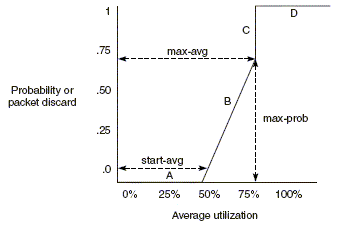
A RED slope is a graph with an X (horizontal) and a Y (vertical) axis. The X-axis plots the percentage of shared buffer utilization, from 0 to 100%. The Y-axis plots the probability of packet discard marked from 0 to 1. The slope can be defined as four sections, as shown in the following diagram
Section A is (0, 0) to (start-avg, 0). For this part of the slope, the packet discard value is always zero, which prevents the RED function from discarding packets when the shared buffer average utilization falls between 1 and start-avg.
Section B is (start-avg, 0) to (max-avg, max-prob). This part of the slope is a linear slope where packet discard probability increases from zero to max-prob.
Section C is (max-avg, max-prob) to (max-avg, 1). This part of the slope shows the increase of packet discard probability from max-prob to one. A packet discard probability of one results in an automatic discard of the packet.
Section D is (max-avg, 1) to (100%, 1). For this part of the slope, the shared buffer average utilization value of max-avg to 100% results in a packet discard probability of one.